Posts

MACHYN'S DIARY

Image
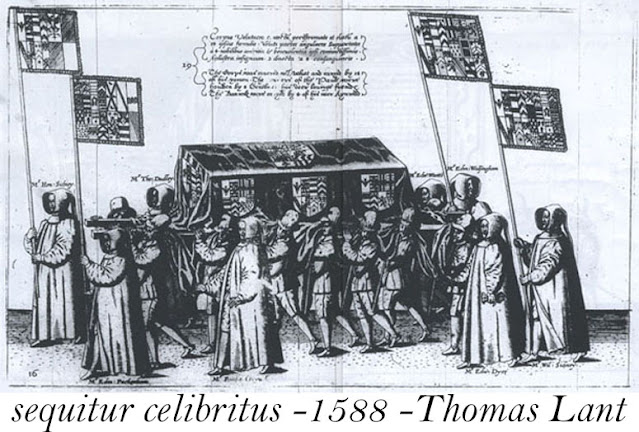
  The Diary of Henry Machyn, Citizen and Merchant Taylor of London, 1550 - 1563 [ed. J.G. Nichols, Camden Society first series, 42 (London, 1848)  http://www.british-history.ac.uk/camden-record-soc/vol42 (accessed 28 January 2024)] Extracts from the  PREFACE : (editor)         ' The writer was a citizen of London, of no great scholarship or attainments, as his language and cacography plainly testify, sufficiently prejudiced no doubt, and not capable of any deep views either of religious doctrine or temporal policy; but the matters of fact which he records would be such as he either witnessed himself, or had learned immediately after their occurrence: and the opinions and sentiments which he expresses would be shared by a large proportion of his fellow citizens.'         ' The Diary, in fact, originated from the nature of the writer's business as a furnisher of funeral trappings; and it is at first a mere record of the principal Fune...
"No. 1"

Image
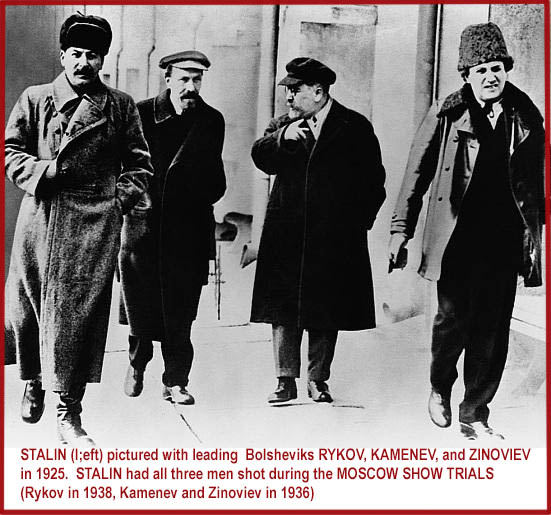
DARKNESS AT NOON    written by Arthur Koestler 1938-1940 Translated by Daphne Hardy and published by Macmillan 1941  <files.libcom.org/files-"Arthur-Koestler"-Darkness-at-Noon.pdf> The cell door slammed behind Rubashov ... An hour earlier, when the two officials of the People's Commissariat of the Interior were hammering on Rubashov's door in order to arrest him, Rubashov was just dreaming that he was being arrested ... Then the light blazed on and the mist parted ... He dried his forehead and the bald patch on the back of his head with the sheet, and blinked up with already returning irony at the colour-print of No. 1, leader of the Party, which hung over his bed on the wall of his room ― and on the walls of all the rooms next to, above, or under his; on all the walls of the house, of the town, and of the enormous country for which he had fought  and suffered, and which now had taken him up again in its enormous protecting lap. He was now fully awake; but the ...

HOMAGE TO CATALONIA

Image
ONE HOMAGE  TO CATALONIA  by George Orwell    (Copyright Eric Blair 1938)  <fadedpage.com/#20181044-a5.pdf>        As the road struck into the sierra we branched off to the right and climbed a narrow mule-track that wound round the mountain-side ... In the distance you could see our 'position' at the crown of the horseshoe; a ragged barricade of sandbags, a red flag fluttering, the smoke of dug-out fires.  A little nearer and you could smell a sickening sweetish stink that lived in my nostrils for weeks.  Into the cleft immediately behind the position all the refuse of months had been tipped ― a deep festering bed of breadcrusts, excrement, and rusty tins.        The company we were relieving were getting their kits together. They had been three months in the line; their uniforms were caked with mud, their boots falling to pieces, their faces mostly bearded ... a few stray bullets were cracking high overhe...

THE ROAD TO WIGAN PIER

Image
ONE The Road To Wigan Pier   (Pt 1)  by George Orwell  (Eric Blair 1937, Victor Gollancz 1947, Secker & Warburg 1949, Penguin 1962)         The train bore me away, through the monstrous scenery of slag-heaps, chimneys, piled scrap iron, foul canals, paths of cindery mud criss-crossed by the prints of clogs. This was March, but the weather had been horribly cold and everywhere there were mounds of blackened snow. As we moved slowly through the outskirts of the town we passed row after row of little grey slum houses running at right angles to the embankment. At the back of one of the houses a young woman was kneeling on the stones, poking a stick up the leaden waste-pipe which ran from the sink inside and which I suppose was blocked. I had time to see everything about her ― her sacking apron, her clumsy clogs, her arms reddened by the cold. She looked up as the train passed, and I was almost near enough to catch her eye. She had a round, pale fa...