Posts

Showing posts with the label STANDING STONES

5. Valuations and Envy

Image
'Laws annexing ecclesiastical first fruits and tenths to the king necessitated "Commissioners of the Tenth" being appointed throughout the country to establish all church wealth in England and Wales. This survey, undertaken in the spring and summer of 1535, resulted in the Valor Ecclesiasticus  records, used as a basis for clerical taxation'. A central debate in the mind of Henry VIII was about the revenue of Church and the contributions it should make to the State. In a highly charged Reformation setting, the King could hardly demand the Annates, Peter's Pence, and Indulgence Sales, that had previously gone to the Pope in Rome. The language had to be changed at least.  Henry did not want to halt the river of money. He wanted to divert the income stream to his own treasury. But for that he needed new names and Protestant methods.  The mechanism devised by his Secretary, Thomas Cromwell, was contained in  26 Henry VIII, c. 3  (1534). This was "An Act concernin...

4. Visitations and Vice

Image
  The Act of Supremacy  in 1534 gave Henry VIII extraordinary powers. As Supreme Head of the Church of England the king was entitled to reform it in any way he thought necessary "and from time to time correct errors and enormities in the Church, by visitations or otherwise". His newly appointed Vicar-General, Thomas Cromwell, took this responsibility seriously. Cromwell charged a number of men as "royal visitors" and sent them out to survey and assess the moral health of all monasteries and nunneries throughout England and Wales. Clergyman Richard Layton, lawyer Thomas Legh, and notary clerk William Blyth, conducted the Northern Visitation over two months in early 1536. Their work informed the last part of the damning Compendium Compertorum , which was published to Parliament in time to promote the passing of  An Act for the Suppression of Lesser Monasteries. The Visitors understood they had a reforming task at the institutions they inspected. Their benchmark for im...

3. Stirring Up this Pestilent Sedition

Image
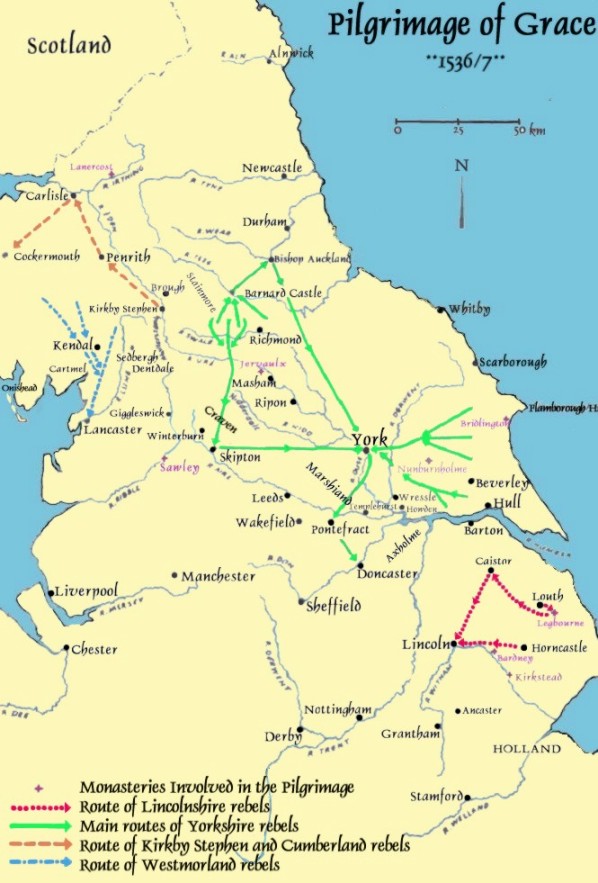
  Two separate but similar incidents show that the Pilgrimage of Grace was "a rising of the commons". These events marked the start of local rebellions in the East Riding of Yorkshire and the northwest county of Cumbria. They were triggers of small revolts that grew into one large protest against religious change. Rebel John Hallom testified that "in bidding the beads" on the Sunday before St Wilfrid's Day (observed 12 October), the priest at Walton Church (near Beverley) did not mention the feast day. Hallom asked the priest why he left it out "for it was wont to be a holyday here". The priest replied by informing the parishioners that it and other feasts "were put down by the king's authority". After mass the whole parish "was in a rumour and said that they would have their holydays bid and kept as before". From that point on, according to Hallom, "no man could keep his servants at the plow". [ Letters and Papers , v...

2. Traitors Under the Treasons Act

Image
Blackstone's Commentary on the Laws of England thunders against "the bloody reign of Henry VIII", when the "spirit of inventing new and strange treasons was revived."  The lawyer describes a contemporary method of execution that emphasised the special disgrace and notoriety of that crime, as if hanging traitors was not enough. It required: 1.  That the offender be drawn to the gallows.  2.  That he be hanged by the neck, and then cut down alive. 3.  That his entrails be taken out, and burned, while he is yet alive. 4.  That his head be cut off. 5.  That his body be divided into four parts. 6.  That his head and quarters be at the king's disposal.   With this horrific deterrence in mind, it is clear that any extended definition of High Treason would be of public concern. In fact, successive Acts passed in 1534 did increase the reach of  treasonous behaviour, and quite significantly. The First Act of Succession ( 25 Henry 8, c. 22 ) decla...

1. Suppressing the Lesser Monasteries

Image
Dissolution of the Monasteries under Henry VIII occurred in two stages. The first move took place during 1535 and 1536 with the "suppression" of 213 "lesser" monasteries. The second phase, from 1537 until 1540, saw the "surrender" of the remaining religious houses through a process of "negotiating". Marking the dividing point of the alternate systems of "closure" was a series of rebellions in the north of England, collectively called the Pilgrimage of Grace. It was the quashing of these revolts, and severe punishment of the ringleaders, that enabled the King's officers to proceed from "suppression of the lesser monasteries" to the peaceful "surrender" of the rest. In the aftermath of the Lincolnshire, Yorkshire and Cumberland uprisings, some 216 rebels were executed for treason, including at least six abbots, 38 monks, and 16 priests. Many of them suffered the ultimate sentence:       "And on 25 day of May 1...