Posts

Showing posts with the label Human Era 1

Long Glacial

Image
  Only a small part of Australia was actually glaciated during the Last Glacial Maximum (LGM), in the Snowy Mountains and Tasmania.  On the Kosciuszko Massif, terminal moraine dates at Blue Lake are between 22.3 thousand rears ago (ka) and 19.3 ka. At Cradle Mountain - Lake St Clair, Tasmania's largest Glacier at 27 kilometres (kms) long and 350 metres thick, dates are from 20.5 ka to 18.8 ka. Calibrated dating of most of the mainland and Tasmanian glaciers has indicated their greatest extent to have been from about 22,000 to 19,000 years before present (YBP). This date range gives a reasonably precise time frame for the most severe period of the LGM in Australia. Avoiding continental coverage by ice sheets was fortunate, but did not mean escaping a serious downturn in climatic conditions. Australia experienced a decline in average annual temperatures of up to 10⁰C and a 60% reduction in rainfall. Significant cooling and aridity produced a change in vegetation towards steppe-l...
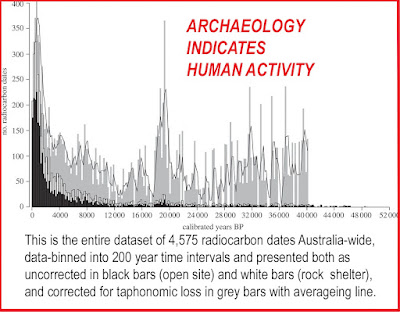
Population Curve

Image
  The discipline of numbers can give stunning insights into early human experience. This is true of the Aboriginal occupation of Australia. Demographic work by a group of archaeologists has shown the probability of a perilously small population of homo sapiens  inhabiting this large continent for about 80% of its 'human era'. Beginning with 2-3,000 migrants from South East Asia 50,000 years ago, total numbers may not have exceeded 20,000 until exponential growth took off in the Holocene. Before that the prehistory of Aborigines seems to be a story of extreme vulnerability to climate change and their bare survival as a viable gene pool. The underlying assumption of work by Alan Williams and others (2013) is that dateable archaeology is evidence of human activity, and by extension, the level of population. An increase in radiocarbon dates over time demonstrates a rise in people doing things, and implies that more people are involved in the doing. The idea of using proxies in pal...

Absent Archaeology

Image
  There is good evidence for Aboriginal occupation of Victoria's South West Coast after  the Last Glacial Maximum circa 20,000 years ago. In the west around Discovery Bay and Cape Bridgewater, archaeology begins at 13,250 years before present ( ybp) at South Cave. In the east around Cape Otway it starts later in 1,420 ybp at Seal Point. What seems to be missing, however, are reliable signs of human presence before  the cold dark days of the last Ice Age. It is generally accepted that people first crossed over into the continent of Sahul about 50-55,000 years ago. They then proceeded to colonise as much of of it that was accessible and hospitable by about 45,000 years ago. The pattern of exploration was one of following the littoral, with its bounty of shellfish and sea-wrack. Given this strategy, there was no apparent reason why the pioneers of this migration did not eventually come to the shoreline of western Victoria in Australia's south east. There have been some elusi...

Vanishing Coastlines

Image
  An easy way to understand 'natural' climate change is to imagine an Ice Age coming every 100,000 years or so. Climate change normally occurs in reasonably regular cycles. This has been the pattern over the last 7-800,000 years. The scientific for Ice Age is Glacial. This name refers to major cold episodes in the Earth's history, when continental ice sheets form, glaciers advance, and sea levels fall. The periods between Ice Ages are called Interglacials. These are times when polar ice caps shrink and glaciers retreat. Their released melt-water then raises sea levels again. We currently reside in one of these warmer phases. The last complete glacial cycle took place between 130,000 and 20,000 years ago. The particular details of this approximately 110,000 year long event have been 'mapped' according to Marine Isotopic Stages (MIS). This involves comparing oxygen isotope ratios preserved in the carbonate shells of long dead marine organisms. Geologists argue that di...