Posts

Peveril's Arse

Image
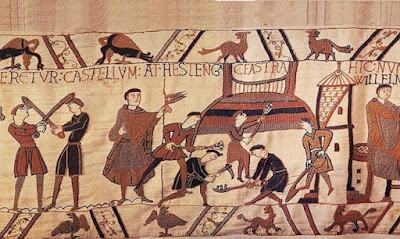
The military mind-set of William the Conqueror was obvious from the start. The first thing he did on landing his army on the south coast of England was to build a castle. The Chronicle of Battel Abbey  reports, "The duke...did not long remain in that place, but went away to a port not far distant called Hastings, and there, having secured an appropriate place, he speedily built a castle of wood." His initial act of castle-building is captured on the Bayeux Tapestry . The Latin inscription reads, "This man has commanded that a fortification should be thrown up at Hastings". The scene is of a 'motte and bailey' castle in the making. Men with spades pile up a defensive mound of dirt. A wooden structure appears on top. The motte was an artificial hill, constructed by piling consecutive layers of earth and stones, compacting each one before laying the next. Sides were steep and covered with clay to deter attackers. A timber tower was erected on the flattened area...

Irritating the Conqueror

Image
       In the year of our Lord 1066, the Lord, who ruleth all things, accomplished what He had long designed with respect to the English nation; giving them up to destruction by the fierce and crafty race of the Normans...         Meanwhile, William Duke of Normandy, was inwardly irritated and deeply incensed...because Harold, committing perjury, had usurped the kingdom, which by right of relationship belonged to himself. William, therefore, assembling the principal men of Normandy, called on them to aid him in the conquest of England.        Thus the hand of the Lord brought to pass the change which a remarkable comet had foreshadowed in the beginning of the same year: as it was said:        "In the year 1066, all England was alarmed by a flaming comet."                                             ...

Battle Abbey

Image
William the Conqueror and his barons are generally thought of in terms of brutality. To Anglo-Saxon observers they were formidable and unforgiving warriors. In private though, Norman instincts were often towards sanctity, or at least calculated superstition. William's foundation of Battle Abbey illustrates this side of the invaders' personalities. The Chronicle of Battel Abbey  begins with two versions of William's decision to establish a monastery on the site of the Battle of Hastings (1066). 'The History of the Foundation of Battel Abbey' was written by a monk "having at hand certain records...concerning the site and establishment of our place".  On the morning of the battle, "there was brought forth a coat of mail for the duke to put on". As the duke was dressed in his armour, he is supposed to have "uttered these memorable words...        'Wherefore, now, secure of His [God's] aid, and in order to strengthen the hands and courage...

1066: A Turbulent Year

Image
This blog presents two very different views of 1066. First is from the English side, using the contemporary account called the Anglo-Saxon Chronicle . The theme here is 'calamity'. Second is from the Norman side, using the text embroidered into the Bayeux Tapestry . The theme in this case is 'justification'.  Both histories are steeped in the values of Christendom. They appeal to either side of the same coin. There is no sense of irony in these records of actual events. Each side is sincere in their belief in the rightness of their cause. Because the 'authors' report the same things (the Battle of Hastings etc) and see them through the same (or similar) religious lens, their conclusions are depressingly predictable ― God punishes sinners, God rewards the just. The point of using these two original sources is that, despite the authors' best efforts, current readers are unlikely to come away with the same fatalism. The sadness of the first version and the triu...

MA HUAN

Image
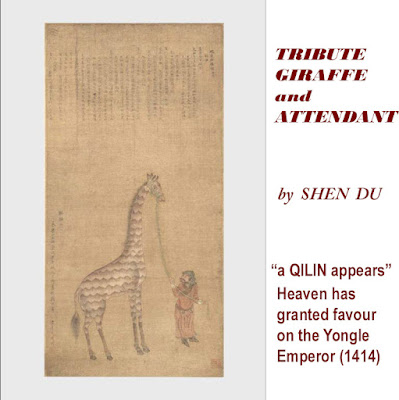
  Serving as an official translator, Ma Huan travelled on three of Cheng Ho's voyages ― the fourth (1413-1415), sixth (1421-1423), and seventh (1431-1433).  In a 'Notice' or 'Foreword' written in 1416, after his first journey with the Ming fleet, he declared:        "I followed the [mission] wherever it went, over vast expanses of huge waves for I do not know how many millions of li ; I saw [these countries] with my own eyes and I walked [through them] in person. So I collected [notes about] the appearance ['ugliness or handsomeness'] of the people in each country, [and] about the variations ['dissimilarity or similarity'] of the local customs, also [about] the differences in the natural products, and about the boundary-limits. I arranged [my notes] in order so as to make a book, which I have entitled The Overall Survey of the Ocean's Shores  [ Ying-yai Sheng-lan ]." In fact, it is doubtful that Ma personally visited every one of the tw...