Posts

God's Builder Gundulf
Image
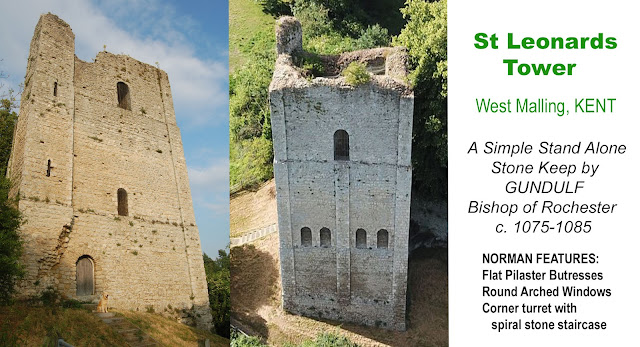
  ...bishop Gundulf, seeing as he was in masonry work the greatest and the ablest, might from his own means build a stone castle for [the king] at Rochester...                Textus Roffensis   Written by a monk of the Priory of St Andrew the Apostle in Rochester, probably decades after the negotiations it describes, the praise of his bishop could be overdone. However, Gundulf's reputation was based on more hearsay and legend.  He may, or may not, have been the architect of the Tower of London and Colchester Castle, but the evidence of his construction of monastic and defensive buildings in Kent is more convincing. THE TWO TOWERS Predating Gundulf's ecclesiastic structures were a couple of tall stone towers. While they don't match the squat, massif  footprints of contemporary castle keeps like Chepstow or Colchester, they were stand-alone fortified buildings. Gundulf's Tower at Rochester had walls 6 feet thick enclosing a groun...

The Lustre of a Single Shilling

Image
  William fitz Osbern was a close companion of William the Conqueror. He owed his position at the Duke of Normandy's right hand to his skill and loyalty as a soldier. But he was also quick-witted. Fitz Osbern made the jokes, defusing awkward situations among tense fighting men. The Chronicle of Battel Abbey  mentions a couple of occasions where he saved his leader from looking ridiculous. These occurred in the immediate lead up to the Battle of Hastings, when emotions were already at a high pitch. On the landing of the fleet:        "The soldiers leaped joyfully upon English ground at intervals along the shore. It happened as the duke left his ship, that he fell upon his face, making his nose somewhat bloody on the beach, and grasping the earth with his outstretched hands. Many of the bystanders feared the consequences of so unlucky a presage and stood whispering together. But the duke's sewer [household steward and food taster], William Fitz-Osbert, a man ...

Peveril's Arse

Image
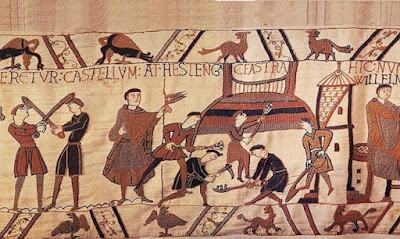
The military mind-set of William the Conqueror was obvious from the start. The first thing he did on landing his army on the south coast of England was to build a castle. The Chronicle of Battel Abbey  reports, "The duke...did not long remain in that place, but went away to a port not far distant called Hastings, and there, having secured an appropriate place, he speedily built a castle of wood." His initial act of castle-building is captured on the Bayeux Tapestry . The Latin inscription reads, "This man has commanded that a fortification should be thrown up at Hastings". The scene is of a 'motte and bailey' castle in the making. Men with spades pile up a defensive mound of dirt. A wooden structure appears on top. The motte was an artificial hill, constructed by piling consecutive layers of earth and stones, compacting each one before laying the next. Sides were steep and covered with clay to deter attackers. A timber tower was erected on the flattened area...

Irritating the Conqueror

Image
       In the year of our Lord 1066, the Lord, who ruleth all things, accomplished what He had long designed with respect to the English nation; giving them up to destruction by the fierce and crafty race of the Normans...         Meanwhile, William Duke of Normandy, was inwardly irritated and deeply incensed...because Harold, committing perjury, had usurped the kingdom, which by right of relationship belonged to himself. William, therefore, assembling the principal men of Normandy, called on them to aid him in the conquest of England.        Thus the hand of the Lord brought to pass the change which a remarkable comet had foreshadowed in the beginning of the same year: as it was said:        "In the year 1066, all England was alarmed by a flaming comet."                                             ...

Battle Abbey

Image
William the Conqueror and his barons are generally thought of in terms of brutality. To Anglo-Saxon observers they were formidable and unforgiving warriors. In private though, Norman instincts were often towards sanctity, or at least calculated superstition. William's foundation of Battle Abbey illustrates this side of the invaders' personalities. The Chronicle of Battel Abbey  begins with two versions of William's decision to establish a monastery on the site of the Battle of Hastings (1066). 'The History of the Foundation of Battel Abbey' was written by a monk "having at hand certain records...concerning the site and establishment of our place".  On the morning of the battle, "there was brought forth a coat of mail for the duke to put on". As the duke was dressed in his armour, he is supposed to have "uttered these memorable words...        'Wherefore, now, secure of His [God's] aid, and in order to strengthen the hands and courage...