Posts

UNDER BELLY

A young upper-class Englishman slumming it in the poorer suburbs of Berlin hardly seems a promising start to understanding the last years of the Weimar Republic. An unattributed quote in a Wikipedia article on Christopher Isherwood suggests otherwise: " Goodbye to Berlin  is his portrait of a city in which Adolf Hitler was rising to power ― enabled by poverty, unemployment, increasing attacks on Jews and Communists, and ignored by the defiant hedonism of night life in the cafes, bars and brothels". In March 1929, Isherwood aged 25 years, joined his schoolfriend Wystan (WH) Auden for a ten day visit. He returned there in July and finally moved there in November. Isherwood remained resident in Berlin until May 1933, when he was forced to flee the new Nazi regime with his German boyfriend Heinz Neddermeyer. His relevant stories are based on raw material recorded in his diary while he was there:       Mr Norris Changes Trains , a novel published in 1935,     ...

TRAIN TIME

  That year, 1931, for the first and last time in my life, I deliberately set out to write a book to please, one which with luck might be made into a film. So recalled the English author Graham Greene. The book, which he self-consciously titled "An Entertainment", was published in 1932 as Stamboul Train (in the UK) and Orient Express  (in the US). The overnight-train theme was apparently popular in the Interwar Years. Greene admits that "before I completed the book, Marlene Dietrich had appeared in Shanghai Express  (1932), the English had made Rome Express  (1932), and even the Russians had produced their railway film Turksib ". Agatha Christie's book Murder on the Orient Express  (UK) and Murder in the Calais Coach  (US) followed in 1934.   While both the books, Stamboul Train  and Murder on the Orient Express,  concern journeys on the express train service between Paris and Istanbul, they are very different in style. Greene's story is...

CONFIDENCE TRICK

  During the interwar years from 1919 to 1939, Britain continued to rule over a vast global empire. Millions of non-Britons were seemingly compliant with the wishes of a relative handful of white administrators, traders and planters. That this preposterous bluff worked at all was a mystery that intrigued contemporary authors. Of writers like Joseph Conrad and Graham Greene, it is probably W Somerset Maugham who came closest to describing the colonial 'type', of intuiting the 'trick' of colonist confidence. His short fiction has become associated with the Federated Malay States (FMS) and British North Borneo (BNB) in particular. Through his stories collected in The Casuarina Tree  (1926) and Ah King  (1933), Maugham delivers an astute understanding of how a few Englishmen and their wives 'got away' with dominating many more Malays, Dayaks, Chinese and Tamils.  Maugham is reminded of the Casuarina trees he observed in the otherwise luxuriant jungle. They were ...

5. Valuations and Envy

Image
'Laws annexing ecclesiastical first fruits and tenths to the king necessitated "Commissioners of the Tenth" being appointed throughout the country to establish all church wealth in England and Wales. This survey, undertaken in the spring and summer of 1535, resulted in the Valor Ecclesiasticus  records, used as a basis for clerical taxation'. A central debate in the mind of Henry VIII was about the revenue of Church and the contributions it should make to the State. In a highly charged Reformation setting, the King could hardly demand the Annates, Peter's Pence, and Indulgence Sales, that had previously gone to the Pope in Rome. The language had to be changed at least.  Henry did not want to halt the river of money. He wanted to divert the income stream to his own treasury. But for that he needed new names and Protestant methods.  The mechanism devised by his Secretary, Thomas Cromwell, was contained in  26 Henry VIII, c. 3  (1534). This was "An Act concernin...

4. Visitations and Vice

Image
  The Act of Supremacy  in 1534 gave Henry VIII extraordinary powers. As Supreme Head of the Church of England the king was entitled to reform it in any way he thought necessary "and from time to time correct errors and enormities in the Church, by visitations or otherwise". His newly appointed Vicar-General, Thomas Cromwell, took this responsibility seriously. Cromwell charged a number of men as "royal visitors" and sent them out to survey and assess the moral health of all monasteries and nunneries throughout England and Wales. Clergyman Richard Layton, lawyer Thomas Legh, and notary clerk William Blyth, conducted the Northern Visitation over two months in early 1536. Their work informed the last part of the damning Compendium Compertorum , which was published to Parliament in time to promote the passing of  An Act for the Suppression of Lesser Monasteries. The Visitors understood they had a reforming task at the institutions they inspected. Their benchmark for im...

3. Stirring Up this Pestilent Sedition

Image
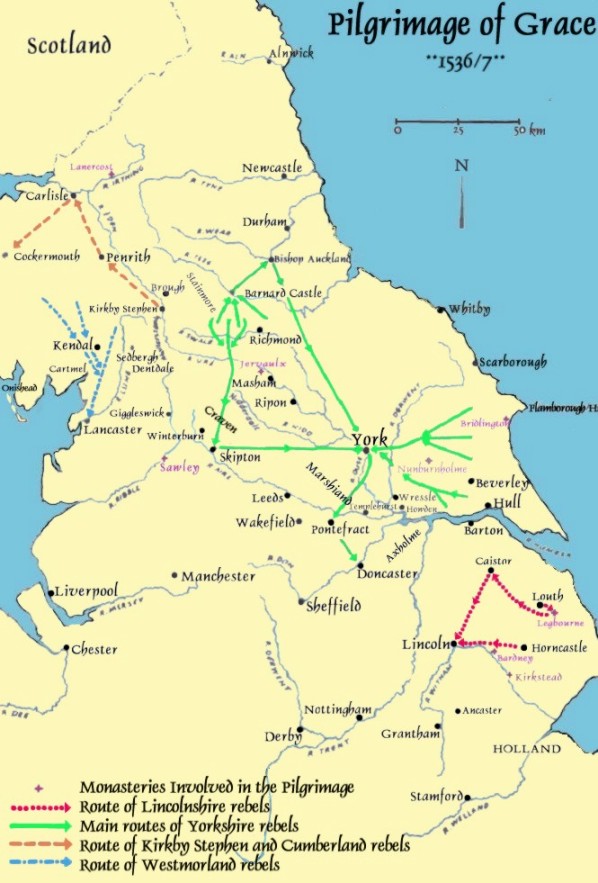
  Two separate but similar incidents show that the Pilgrimage of Grace was "a rising of the commons". These events marked the start of local rebellions in the East Riding of Yorkshire and the northwest county of Cumbria. They were triggers of small revolts that grew into one large protest against religious change. Rebel John Hallom testified that "in bidding the beads" on the Sunday before St Wilfrid's Day (observed 12 October), the priest at Walton Church (near Beverley) did not mention the feast day. Hallom asked the priest why he left it out "for it was wont to be a holyday here". The priest replied by informing the parishioners that it and other feasts "were put down by the king's authority". After mass the whole parish "was in a rumour and said that they would have their holydays bid and kept as before". From that point on, according to Hallom, "no man could keep his servants at the plow". [ Letters and Papers , v...